Put premiums, plausible care costs and uncertainty on the same time scale before choosing between hypothetical plan options.
The option with the smaller payroll deduction may or may not be less expensive over a full coverage year. It depends on the deductions you actually pay, the care you use and the plan’s cost-sharing rules. Compare those pieces on the same time scale and keep uncertain inputs visibly uncertain.
HealthCare.gov’s total-cost guidance encourages comparing estimated annual costs rather than premiums alone. Its page is written for Marketplace plans. The exercise below adapts that comparison idea to fictional employee contribution amounts; it does not quote an employer plan or assume that any option is available to you.
Convert the contribution correctly
Suppose fictional Option A costs an employee $55 on each of 24 deduction dates, while Option B costs $90 on each of 24 dates. Annual employee contributions are $1,320 and $2,160, respectively. That is an $840 difference before considering care. If your actual deduction schedule has a different count, use that count instead.
“Per paycheck,” “twice monthly,” “every two weeks” and “monthly” are different units. Do not multiply every per-paycheck amount by 24, or every monthly amount by 26. Confirm how many deductions apply over the coverage period, including any partial-year or special schedule.
Use scenarios instead of a false forecast
| Scenario | Option A | Option B | What the result means |
|---|---|---|---|
| Contributions only | $1,320 | $2,160 | A begins $840 lower |
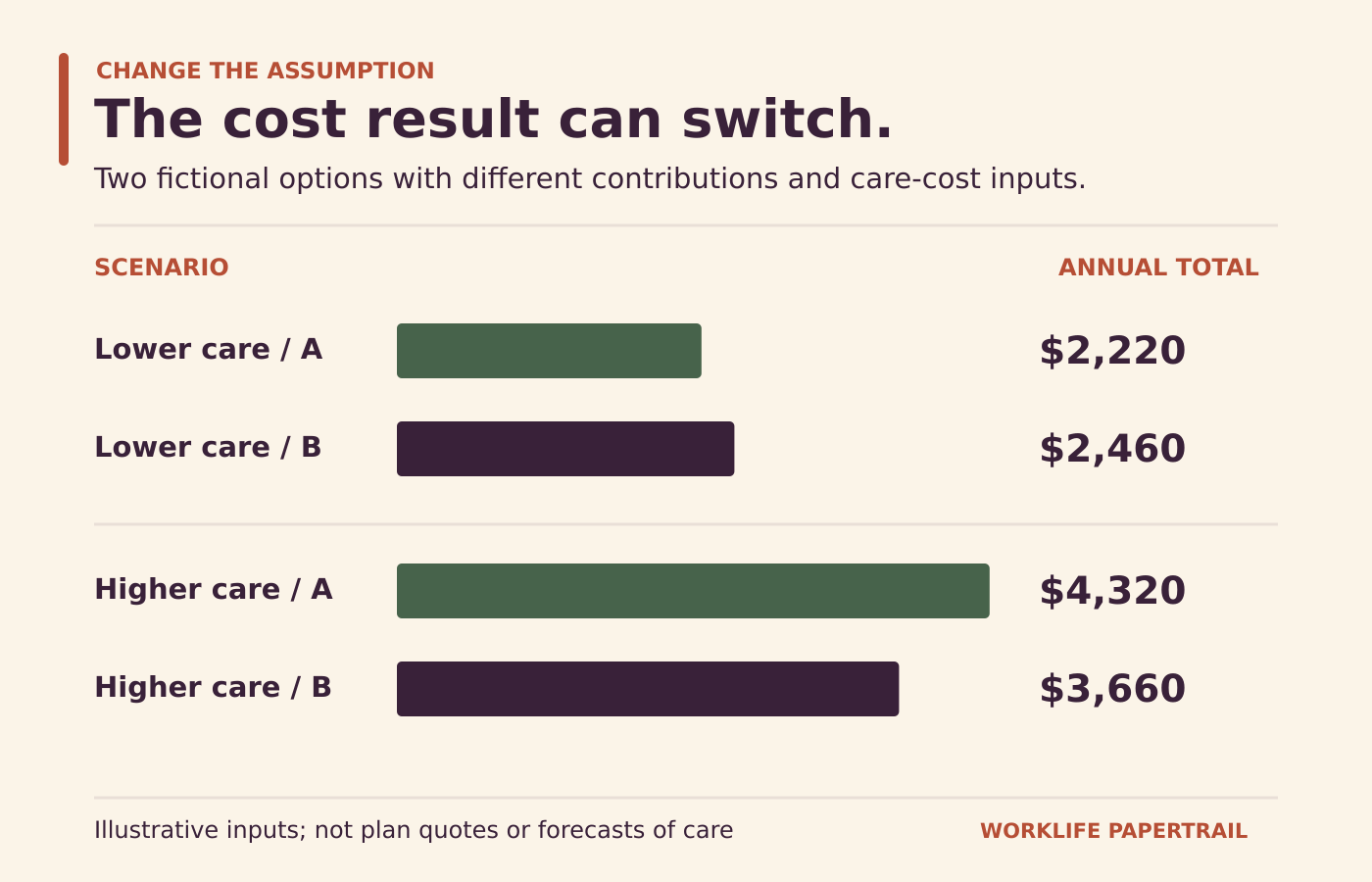
| Illustrative care cost: A $900; B $300 | $2,220 total | $2,460 total | A is $240 lower in this scenario |
| Illustrative care cost: A $3,000; B $1,500 | $4,320 total | $3,660 total | B is $660 lower in this scenario |
The care-cost amounts are invented inputs, not values calculated from a deductible or predictions of medical need. Their purpose is to show how an answer can change when one assumption changes. In a real comparison, derive possible cost-sharing amounts from the applicable documents and clarify unclear services with the plan.
Use the SBC to ask better cost questions
The Summary of Benefits and Coverage helps compare plan features. Look for the relevant network, deductible, copayments, coinsurance and out-of-pocket limits, but also read what counts toward those amounts. A simplified “premium plus deductible” total can mislead if it treats the deductible as a fee everyone necessarily pays in full.
Do not assume an out-of-pocket maximum covers every possible bill. Check the plan’s treatment of premiums, out-of-network care, excluded services and other items. Coverage examples illustrate specified situations; they do not promise the price of your care.
Add questions that numbers cannot answer
- Are the providers and facilities you need in the relevant network, according to a current verified source?
- How are the specific prescriptions or services you expect to use addressed?
- Are referrals, authorization or separate deductibles relevant?
- Does the coverage period or household tier match the cost sheet?
- Could you manage the timing of a larger bill even if annual costs look lower?
These questions do not require sharing medical details with this site. Work privately with the plan’s verified resources. Keep unanswered questions separate from confirmed terms; a blank should not become a zero-dollar assumption.
Write down why the comparison changes
Finish with a conditional conclusion: “Under this contribution schedule and these care-cost assumptions, A is lower; under that scenario, B is lower.” A useful comparison reveals what would change your decision. It does not turn uncertain future care into a precise promise or select insurance on your behalf.