Prepare a dated transition checklist for final pay, benefit notices, tax forms and authorized access to your own records.
Before employment ends, identify how you will obtain your own records afterward and which questions remain open. Do not assume that payroll, health coverage, retirement records and account access all end on the same date. A useful departure plan records each date separately and names the verified resource for a later question.
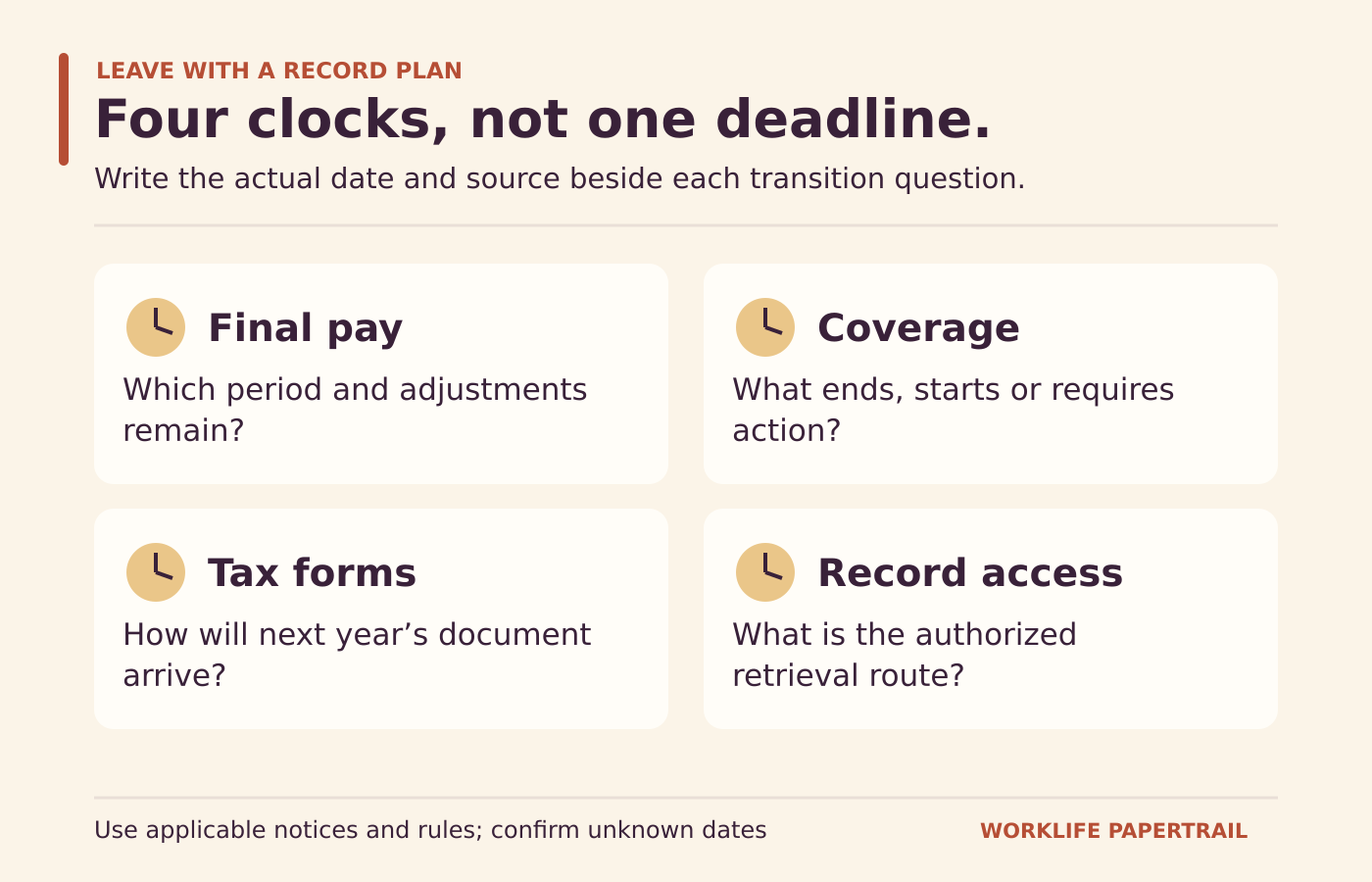
Track four clocks
| Clock | Question | Evidence to retain |
|---|---|---|
| Pay | Which work period and adjustments remain to be paid? | Relevant statements, time records and final-pay explanation |
| Health coverage | When does current coverage end, and what options/notices apply? | Actual termination date, official notices and option-specific deadlines |
| Annual tax records | How will the relevant tax form be delivered later? | Authorized contact and address-update route |
| Record access | How can I obtain my own records after work access changes? | Employer-approved instructions and permitted personal copies |
This checklist does not authorize copying confidential employer documents, customer data or coworkers’ records. Ask for an approved way to retain your own employment documents. Do not forward an entire work mailbox or attempt to retain a login after permission ends.
Separate the last workday from the last payment
The Department of Labor’s final-pay overview says federal law does not require an immediate final paycheck; state requirements can differ. Do not use that statement as a universal deadline. Ask what applies to your work location and circumstances, including any relevant policy or contract.
Review the final statement by period and category. An unused paid-time-off balance should not be assumed to be payable simply because it appears on a screen. Ask for the applicable rule and calculation. Keep any explanation with the balance record that prompted your question.
Give coverage its own timeline
The Department of Labor’s COBRA employee guide and HealthCare.gov’s job-loss coverage guidance describe different potential coverage routes. Availability, cost, notice requirements and deadlines depend on the route and circumstances. An employer’s last workday is not enough information to determine a personal coverage election.
Use a private comparison sheet with columns for option, information source, coverage start, cost, request deadline and unanswered question. Do not assume a request for information is an election or that considering one option preserves every other deadline. Ask the appropriate administrator promptly when a notice is missing or unclear.
Confirm future contact without sharing more than needed
Ask how to update contact information through the employer-approved process and how future tax or benefit notices will be delivered. Verify the route independently before sending personal information. This publication cannot update an address with an employer or request a W-2 on your behalf.
The IRS missing-form guidance is useful if an annual form later fails to arrive or needs correction. Save the appropriate issuer contact now, but recheck the current IRS filing-year instructions when the issue actually arises.
Keep an unresolved-item note
A fictional note might read: “Final hours submitted; last-pay date requested; health-coverage end date received; continuation notice not yet received; future tax-form route confirmed.” This is more useful than a vague “everything complete” label. Each line says what happened and what remains uncertain.
For retirement records, retain the plan identity and official account contact, then use the contribution and vesting guide to understand the documents. Do not let a departure checklist push you into an immediate distribution or rollover decision. Those choices deserve their own review.
Close access cleanly
Return employer property and follow the authorized account and document process. If you discover later that a personal record is missing, use the verified retrieval route rather than trying an old credential or asking a former coworker to access restricted records. A good transition plan preserves your evidence while respecting the boundaries of the systems you leave.