Choose the document that answers your question, then check its plan name, year and coverage level before relying on it.
A benefit summary can describe a plan without proving that you are enrolled in it. An enrollment confirmation can record a selection without explaining every claim rule. Before reading further, identify the question: are you comparing options, checking eligibility, confirming an election or questioning a claim?
Three documents, three starting points
HealthCare.gov’s SBC guidance describes the Summary of Benefits and Coverage as a standardized, plain-language comparison resource. The Department of Labor’s plan-information guidance describes the Summary Plan Description for ERISA-covered plans as an explanation of what a plan provides and how it operates. An enrollment confirmation serves a different practical role: it records what a particular enrollment process says was selected or accepted.
| Record | Useful for | Does not establish by itself |
|---|---|---|
| Summary of Benefits and Coverage | Comparing cost-sharing features and covered-service summaries | That you or a dependent are enrolled |
| Summary Plan Description | Reading participation rules, administration and procedures for an ERISA-covered plan | The outcome of a particular claim |
| Enrollment confirmation | Checking selected option, coverage tier and stated effective date | Every exclusion, appeal rule or later coverage change |
Match the identity before comparing the content
Check the plan name, plan year, option and coverage level. A document with a familiar insurer logo may describe another option offered by the same organization. “Family” and “employee only” are not interchangeable cost units. A prior-year summary can be useful historical evidence, but should not silently become the basis of a current decision.
Keep a short identity line on your private notes: “Plan name; option; year; tier; source.” If a field is missing, mark it unknown. Do not fill it from memory because the document looks familiar. The missing field is itself the next question to ask.
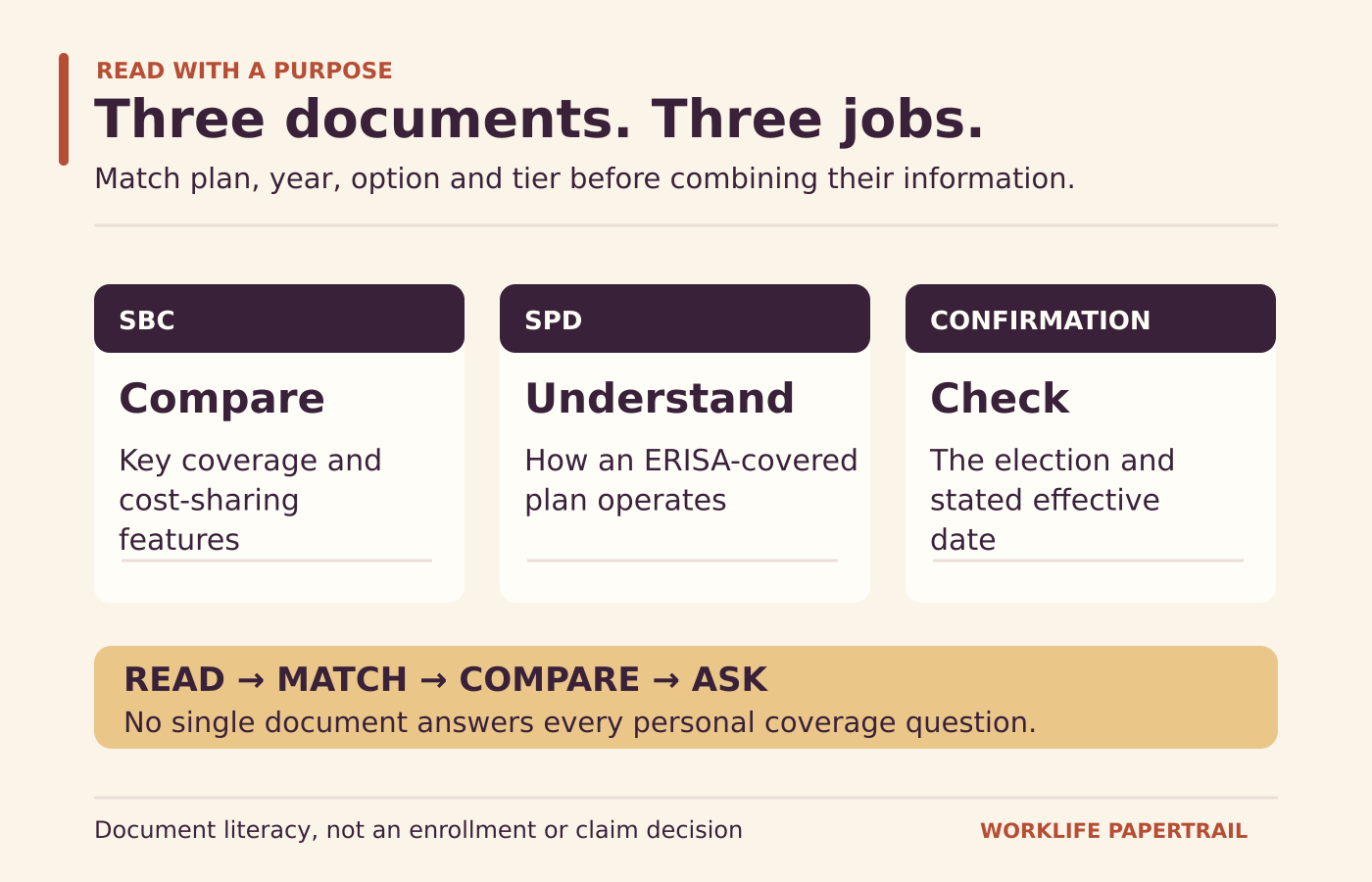
A mismatch that changes the question
In an invented case, a worker saves an SBC for “Option A,” an enrollment confirmation for “Option B” and an old plan summary from the prior year. The worker is trying to understand why a deductible looks different. The first problem is document identity, not an arithmetic mistake.
The focused request is: “Please help me locate the current summary and plan information for the option shown on my confirmation.” After the documents match, the worker can ask about the deductible or other term. This avoids spending time comparing two benefits that were never the same plan.
Read in a useful order
- Orient: identify the applicable document and period.
- Locate: find the section relevant to your actual question.
- Compare: check any related confirmation or later notice.
- Ask: state the unresolved term and the document section.
- Preserve: save the answer and the version it concerns.
This is an editorial reading pathway, not a required employer workflow. You may need a different document, including a governing plan document, insurance certificate, amendment or claim notice. Ask the named administrator what applies rather than assuming one PDF contains everything.
What can this record tell you?
Choose up to three record types. Compare what each document can explain, where it has limits and which kind of resource can answer a question. These are general document descriptions, not a review of your records.
Read every record description without the comparison
Pay statement
- Purpose
- Explain one payment and its earnings, taxes, deductions and net amount
- What it shows
- What amounts were included or withheld in this payment? Period: The named pay period and payment date; year-to-date fields may also appear
- What it cannot prove
- That every hour was recorded, every deduction is correct, or that benefits coverage is active. Federal recordkeeping requirements do not create one universal pay-statement format; state rules vary
- Question to ask
- Which earning or deduction line explains this specific difference for the named pay period?
- Resource type
- Employer's designated payroll process; local time approver for missing hours
- Source-check date
- 2026-09-30
- Public sources
Form W-2
- Purpose
- Report annual wage and tax information
- What it shows
- What annual wage and withholding amounts did the issuing employer or payer report? Period: The calendar tax year printed on the form
- What it cannot prove
- A full benefit election, every pay-period detail, or whether a particular tax return is correct. Use the correct tax year and current IRS instructions; one document alone does not resolve an error
- Question to ask
- Which field and tax year need correction, and who will issue the corrected form?
- Resource type
- Employer or payer named on the form; IRS missing/incorrect-form instructions if needed
- Source-check date
- 2026-09-30
- Public sources
Summary Plan Description
- Purpose
- Describe an ERISA-covered plan's operation and participant rights
- What it shows
- Where are eligibility, claims procedures, vesting or other applicable plan rules described? Period: Its effective version plus later amendments or summaries of material modifications
- What it cannot prove
- That a personal election was received or an individual claim approved. Coverage and plan type matter; check amendments and the actual plan documents
- Question to ask
- Which effective plan version and later amendments explain this eligibility or claim-procedure question?
- Resource type
- The plan administrator identified in plan materials
- Source-check date
- 2026-09-30
- Public sources
Summary of Benefits and Coverage
- Purpose
- Present a standardized health-plan coverage and cost-sharing summary
- What it shows
- What key cost-sharing features and limitations should be compared? Period: The plan or coverage period shown
- What it cannot prove
- Your final medical bill, provider network status today, or enrollment completion. This summary does not replace complete plan terms or current provider/formulary verification
- Question to ask
- Which cost-sharing term applies to the service I am comparing, and where can I check the complete coverage terms?
- Resource type
- Plan administrator, insurer or benefits contact identified in plan materials
- Source-check date
- 2026-09-30
- Public sources
Explanation of Benefits
- Purpose
- Explain how a health claim was processed
- What it shows
- What was billed, allowed, paid by the plan, and assigned to the patient? Period: The claim and dates of service shown
- What it cannot prove
- Whether you have already paid or whether a provider's separate bill matches. An EOB is not a bill; match patient, service dates and claim identifiers carefully
- Question to ask
- How was this claim processed, and does the provider bill match the allowed amount and patient responsibility?
- Resource type
- Health plan claims contact; provider billing office for its bill
- Source-check date
- 2026-09-30
- Public sources
Selections stay on this page. This tool does not send or save them. Don’t enter or upload private information; there is no document-submission function.
When documents disagree
Do not choose the most favorable wording and assume that settles the issue. Record the conflicting passages, dates and document names. Ask the plan’s designated resource which document applies and whether an update or correction is needed. Keep the answer in context rather than extracting one sentence into a permanent personal rule.
Different plan types and legal frameworks can require different disclosures. This guide does not establish that every benefit a reader has is ERISA-covered. It also does not determine eligibility or promise a particular Resourcing Edge benefit package. Public company service descriptions cannot replace your own applicable plan materials.