Separate the workplace, payroll record, benefit plan and public agency before deciding who can answer your question.
A name on a pay statement can be unfamiliar even when the workplace is not. If you see Resourcing Edge in employment paperwork, start by identifying what that particular document does. The organization shown on a payroll document, the person setting your shift, the administrator named in a benefit plan and the agency that explains a legal rule may be different resources.
OneDigital’s public PEO page describes payroll, benefits, HR and risk-management services, including technology it calls re360. That is company-level context. It does not establish which services your employer has selected, which plan covers you, or who approves a particular workplace decision.
Read the document before choosing the destination
Put four labels on a private note: document, question, period and issuer. For example, “pay statement; two hours appear missing; pay period ending September 12; issuer shown on statement” is a solvable starting point. “Resourcing Edge problem” is too broad. It does not tell a recipient whether you mean a schedule, a tax form, a health claim or an account issue.
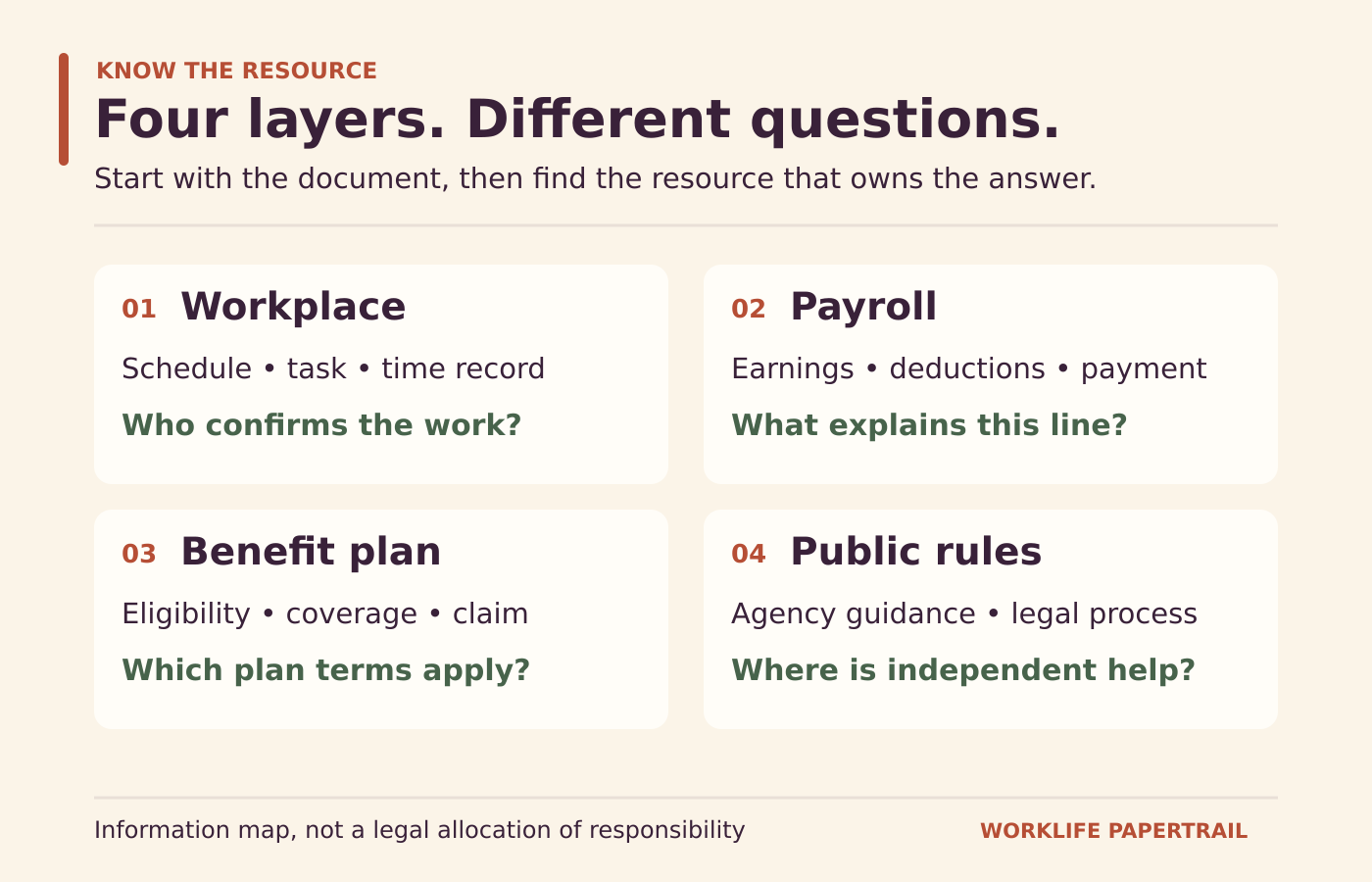
Four layers to keep separate
| Layer | Useful evidence | Question to ask |
|---|---|---|
| Workplace | Schedule, time entry, handbook or supervisor instruction | Who confirms the hours or workplace decision? |
| Payroll administration | Pay statement, pay-period dates, deduction code | Who explains or corrects this payroll line? |
| Benefit plan | Plan name, SPD, SBC or claim notice | Who is the named administrator or claims contact? |
| Public rules | Work location, issue and relevant agency resource | Which agency explains the rule that may apply? |
This is an information map, not a legal allocation of liability. An employment or service agreement can matter, and a PEO relationship does not let a reader infer that the day-to-day employer has no obligations. For a legal dispute, collect the actual documents and use an appropriate agency or qualified adviser.
A worked routing example
Imagine a worker sees a $48 deduction described only by a short code. The worker remembers electing a benefit, but does not know whether the code is for that benefit. The immediate question is not whether the insurer has paid a claim. It is what the payroll code represents, which election it follows and which period it covers.
The worker can collect the statement and enrollment confirmation privately, then ask the employer-designated payroll or benefits contact for the code description and deduction schedule. If the answer identifies a plan, a later eligibility question belongs with that plan’s documents or administrator. Keeping the first request narrow avoids sending a medical history to a payroll contact who does not need it.
Use an answer to narrow the next question
A useful answer has a name or role, an applicable period and a next step. “Ask benefits” may need a follow-up: “Which benefits contact is designated for my plan, and what reference should I include?” An unfamiliar contact should be verified through a route you already trust. Do not forward confidential paperwork simply because an email signature includes a familiar company name.
The Department of Labor’s plan-information page explains the role of the summary plan description for ERISA-covered plans. Its important practical implication here is to locate the actual plan resource, rather than using a general marketing description as your personal terms.
Prepare your next question
Choose a topic to see which records may help, which kind of resource to verify and what this publication cannot decide. No names, record values, health details or account information are needed.
Read all preparation routes
Hours or earnings do not match
Prepare privately:
- Pay-period start and end dates and the relevant work dates
- Your own time notes and the specific hours or earnings line that differs
Resource type: The employer's designated time approver or payroll contact
Next question: Could you help me compare the time record with the earnings line for these dates?
Boundary: Provider workflow varies; the publisher cannot correct payroll
U.S. Department of Labor: Wage and Hour Division ↗ · Read the related article
Annual tax form is missing or incorrect
Prepare privately:
- The tax year and the employer or payer named on the form
- The specific missing or incorrect field; keep full identifiers out of unverified messages
Resource type: Employer or payer, then the IRS route for unresolved missing/incorrect forms
Next question: Which record will be checked, and how will I receive any corrected form for this tax year?
Boundary: Deadlines and substitute-form steps depend on the filing year
IRS: missing or incorrect Form W-2 ↗ · Read the related article
Eligibility or coverage dates are unclear
Prepare privately:
- The effective SPD/SBC version and any relevant amendment
- The enrollment receipt and the precise date or coverage question
Resource type: Plan administrator or benefits contact named in the actual plan materials
Next question: Which plan term and confirmed election determine the coverage start or end date in my situation?
Boundary: A payroll deduction alone is not a coverage decision
U.S. Department of Labor: plan information ↗ · Read the related article
A medical claim or bill looks wrong
Prepare privately:
- The EOB and the separate provider bill
- The service date and claim reference, shared only through the verified channel
Resource type: Plan claims process for benefit decisions; provider billing office for its charges
Next question: Can you explain the disputed line and the actual correction or appeal process, including its deadline?
Boundary: Read the actual appeal notice and applicable deadline; this site does not decide claims
CMS: understanding an Explanation of Benefits ↗ · Read the related article
I need the official account route
Prepare privately:
- Your employer’s current onboarding or support instructions
- The service name you were told to use; do not enter passwords or one-time codes here
Resource type: Your employer's verified instructions or the official Resourcing Edge homepage
Next question: Which official service applies to my worksite, and where does the employer publish the current sign-in route?
Boundary: Public pages currently use different platform names; do not assume one route applies to every worksite
Resourcing Edge: official public homepage ↗ · Read the related article
I need to report a workplace safety concern
Prepare privately:
- The work location, time and factual description
- The worksite’s reporting instructions; get urgent local help rather than waiting for this worksheet
Resource type: Worksite safety contact and official OSHA rights resources
Next question: Which verified workplace or government safety reporting process fits the concern I need to raise?
Boundary: Safety reporting and state workers' compensation claims are separate processes; urgent danger needs immediate local response
OSHA: worker rights and resources ↗ · Read the related article
This tool uses predefined guidance, not an individual assessment. It does not send, save, download or submit your selection. Reset clears the displayed route. Verify actual contact details independently before sharing any record.
When a public agency is the better resource
If the issue concerns a legal requirement or remains unresolved, a public agency may explain options independently of a workplace service chain. The state labor-office directory helps identify the appropriate state resource. A payroll inbox is not a substitute for an agency’s complaint or appeal process, and an informal question should not be assumed to pause a deadline.
Worklife Papertrail is an independent publication. We do not access your records or route cases to Resourcing Edge, OneDigital, an employer or a plan. Use this map to choose a question you can take to the appropriate verified resource.