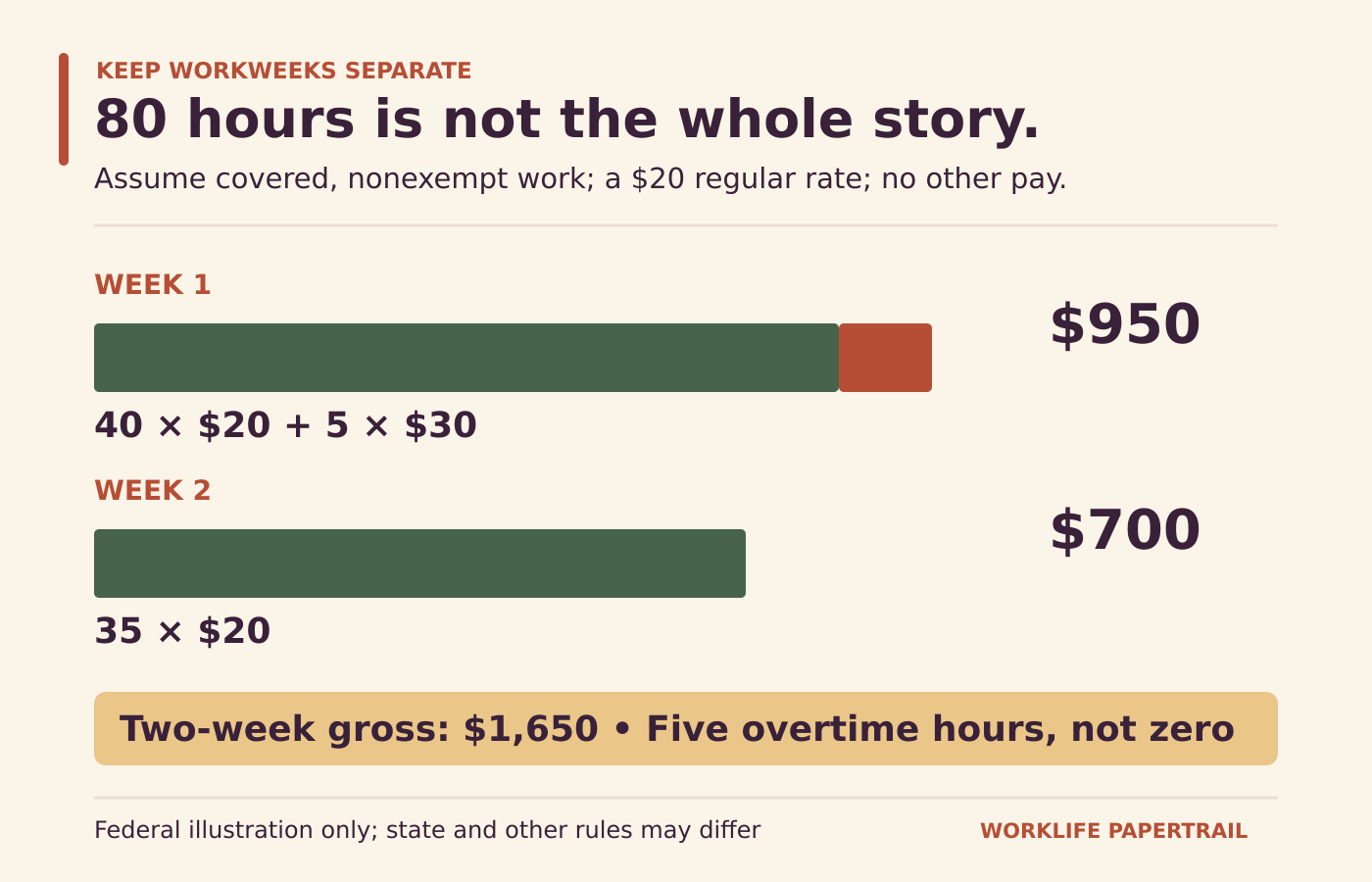
Use a hypothetical 45-hour week and 35-hour week to see why an 80-hour pay-period total can hide an overtime question.
An 80-hour total across two weeks does not by itself answer an overtime question. For a covered, nonexempt employee under the ordinary federal rule, the workweek matters. You must know which hours belong to each defined workweek before evaluating the pay-period total.
Department of Labor Fact Sheet 23 describes a fixed, recurring 168-hour workweek and generally requires overtime after 40 hours worked for covered employees who are not exempt. It says hours cannot be averaged across two or more workweeks. State rules, exemptions and specialized arrangements may require different analysis.
Keep the assumptions visible
This illustration assumes an hourly employee covered by the ordinary federal overtime rule, a $20 regular rate, no bonus or other pay affecting that rate, and hours that are all hours worked. Week one has 45 hours and week two has 35. The example is not a finding about any actual worker or Resourcing Edge payroll configuration.
| Workweek | Straight-time hours | Overtime hours | Illustrative gross |
|---|---|---|---|
| Week one: 45 worked | 40 × $20 = $800 | 5 × $30 = $150 | $950 |
| Week two: 35 worked | 35 × $20 = $700 | 0 | $700 |
| Total: 80 worked | 75 straight-time hours | 5 overtime hours | $1,650 |
Averaging the hours into two 40-hour weeks produces $1,600 at straight time. Under these assumptions, that loses $50 of overtime premium. The difference is not five entire hours of wages, because straight-time pay for those hours was already included in the $1,600 calculation.
Why another statement layout may look different
The same invented $1,650 can be displayed as 80 hours at $20 plus a five-hour premium at $10. That is $1,600 plus $50. It can also be displayed as 75 straight-time hours at $20 plus five overtime hours at $30. Both arithmetic presentations reach the same total under the stated assumptions.
Before concluding that a half-rate line is wrong, ask whether the underlying straight-time amount has already been included. Before concluding that a time-and-a-half line is right, check its hours and rate. A familiar label does not replace reconciliation.
Find the actual workweek boundary
Your employer’s workweek need not match Monday through Sunday or the calendar layout you use at home. Ask for the established boundary relevant to your work. Then arrange your time records around it. A shift near the boundary may make a casual two-week total especially misleading.
Keep actual work time distinct from paid leave in your own comparison. Do not remove or add categories merely to make a total fit. If a time code is unclear, record the code and ask how it is treated. For multiple rates, commissions, nondiscretionary bonuses or other unusual pay, the simple $20 example is insufficient.
Turn the discrepancy into a precise question
An original question structure is: “I’m comparing the workweeks covered by this statement. My record shows 45 hours in the first and 35 in the second. Could you confirm the workweek boundaries and explain the regular-pay and overtime-premium lines?” Replace the invented figures privately and do not claim the example establishes your entitlement.
Keep the response with the time record and statement. If you need guidance about an applicable state rule, use the official state labor-office directory. A conversation about a payroll line is useful, but should not be assumed to extend a legal deadline or resolve a disputed classification.