Reconcile a fictional statement in layers: pay period, earnings, employee deductions and the amount delivered.
Start with the pay period and the pay date, not the largest number. A statement describes an earnings period and a payment event. Once you know which work it covers, follow the money through earnings, deductions and delivery. This order prevents a partial period or a split deposit from looking like an unexplained reduction in pay.
Work a deliberately simplified example
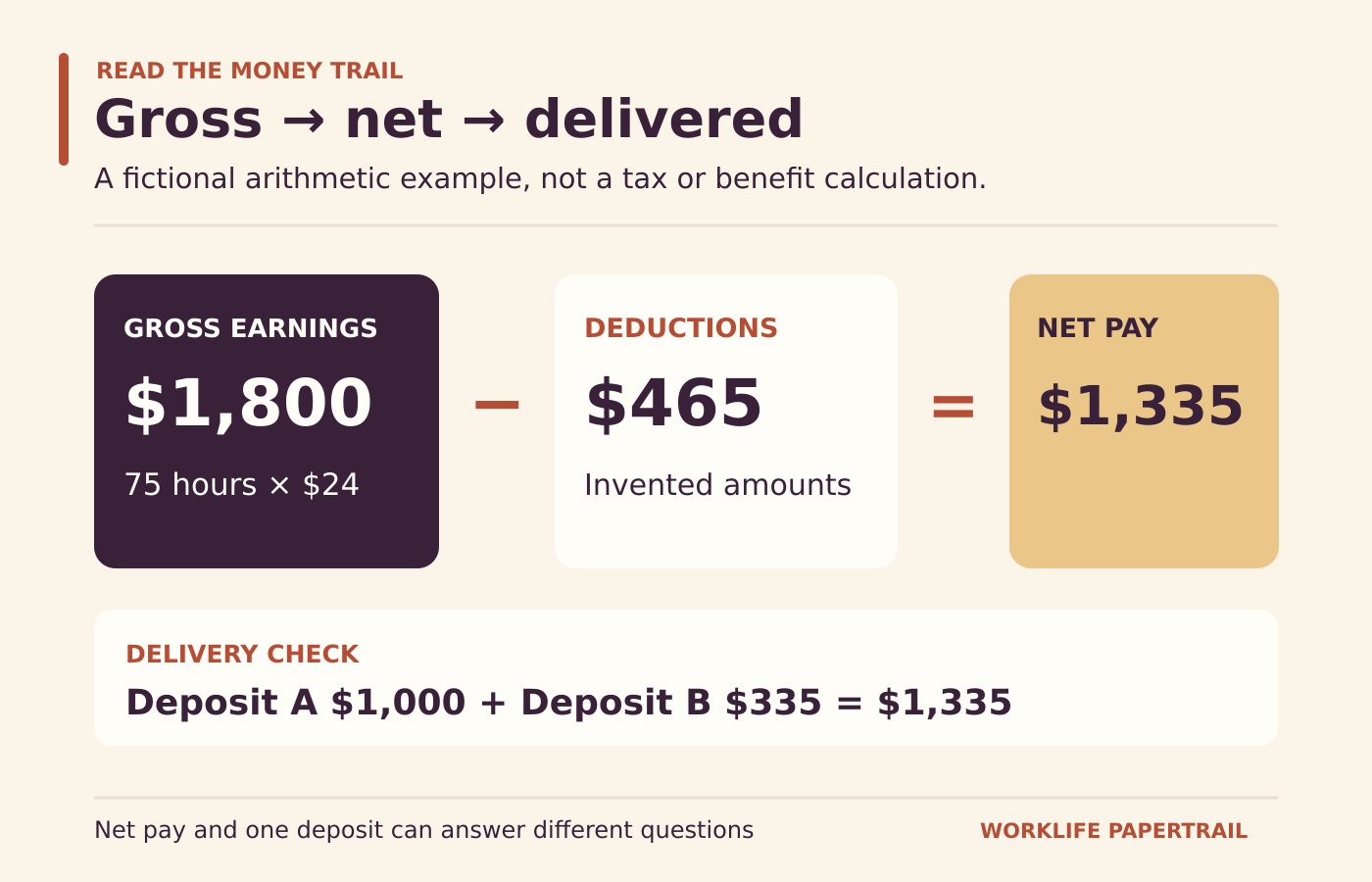
The following invented statement uses one straight-time rate and no overtime, bonus, reimbursement or special tax treatment. Its deduction figures are chosen for arithmetic, not calculated taxes or a typical benefit price.
| Line | Calculation or amount | What it means here |
|---|---|---|
| Hours and rate | 75 × $24.00 | $1,800.00 gross earnings |
| Federal withholding | $130.00 | Invented employee deduction |
| Other employee taxes | $165.00 | Combined illustrative amount only |
| Benefit deduction | $80.00 | Invented election cost |
| Retirement deduction | $90.00 | Invented employee contribution |
| Net pay | $1,800 − $465 | $1,335.00 |
| Deposit A + Deposit B | $1,000 + $335 | $1,335.00 delivered in this example |
Check the earnings layer
Compare the statement’s dates with your time record, then compare the earning categories. Regular hours, overtime, paid leave, bonuses and adjustments may be separate lines. A total-hours figure without its categories can hide why two periods differ. Ask what a code means before treating it as additional or missing work time.
In the fictional example, 75 multiplied by $24 yields $1,800. That confirms only the stated multiplication. It does not prove that 75 is the right number of hours, that $24 is the correct rate, or that every earning category has been included. A good review distinguishes correct arithmetic from complete inputs.
Check deductions without inventing a tax calculation
Add employee deductions and subtract them from the earnings amount used by the statement. An employer contribution shown for information may not reduce your net pay. A year-to-date total should not be subtracted as though it were the current deduction. Read column headings carefully.
Gross pay, federal taxable wages and other taxable-wage figures need not be identical. Different items can receive different tax treatment. The IRS withholding estimator is a separate federal-tax resource; this worksheet does not reverse-engineer taxes from take-home pay. If a tax line is unclear, ask which wage base and election it follows.
Check delivery separately
Net pay and one bank deposit are not always the same number. The example splits $1,335 across two deposits. If you only examine the $1,000 deposit, you create an apparent $335 gap. Use your authorized payment records privately and ask about any payment status or reversal that needs explanation.
Do not assume a statement proves that a bank has received funds. Conversely, a deposit by itself does not explain the earnings and deductions behind it. Those two records answer related but different questions. This publication cannot trace a payment, replace a check or verify a bank account.
Name the difference before raising it
- Period difference: the statement covers different dates than your comparison.
- Input difference: hours, rate or earnings category needs clarification.
- Deduction difference: a code, amount or effective date needs explanation.
- Delivery difference: net pay is understood, but the received amount or timing is unclear.
For hours that cross workweeks, continue with the workweek example. For benefit deductions, use the three-document check. In either case, a concise question should identify the period and exact difference, with sensitive records shared only through the verified employer-designated process.